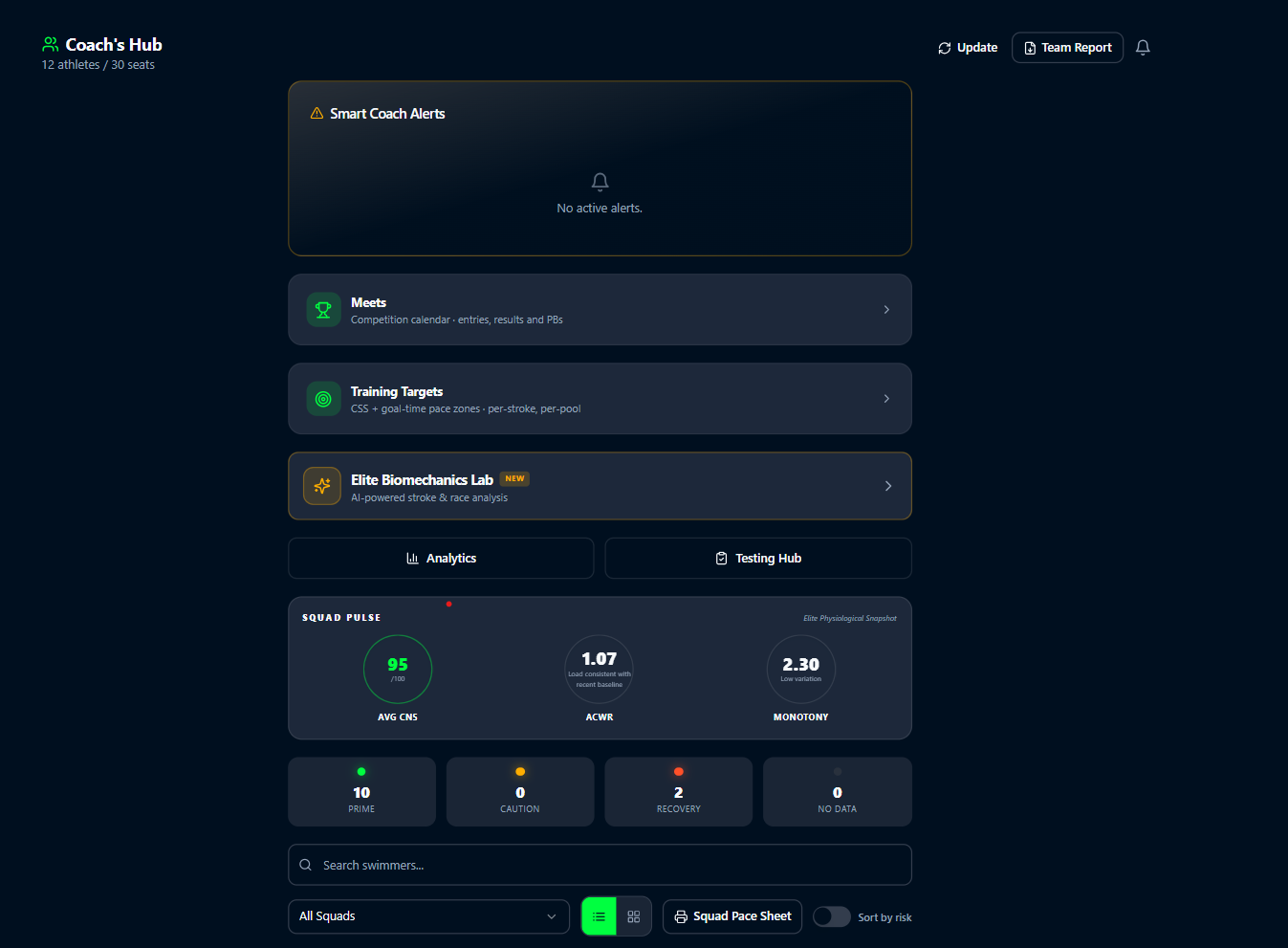
We're two weeks into the season and the platform has already caught something I would have missed.
Tuesday night. Threshold set. Wednesday morning three of the squad checked in amber. Not the three I'd have guessed. One of them had been green all week, solid sleeper, no complaints. But her RPE on Tuesday was a 7 and her energy score Wednesday was a 3. That's a pattern you don't see unless you're looking at the data across the squad at the same time, and I wasn't going to see it at 6am with a coffee in one hand and a session plan in the other.
That's fourteen days of check-ins now. Sleep, soreness, energy, tap test — every morning before they leave the house. Not enough data for proper baselines yet and the app is honest about that. It says "Building baseline" and it should, because the z-scores need more history before they mean anything statistically. But the raw patterns are already there. I know who sleeps badly before a Thursday session. I know who underreports RPE and pays for it forty-eight hours later. I know whose soreness tracks with their load and whose doesn't, which tells me something different entirely.
We tested on the fifth. Full 7×200 step test, every rep timed, heart rates throughout. That feeds straight into CSS, CSS feeds into Urbanchek zones, and the zones are live on every swimmer's phone before I've left the car park. No whiteboard. No spreadsheet I forget to update in week four when someone's dropped two seconds and is now training at 95% of a threshold that doesn't exist any more.
I coached off spreadsheets for years. The CSS went on the board at the start of the block and stayed there. By November someone had moved on and the number hadn't. Close enough isn't close enough when the difference between EN2 and AN1 is three seconds per hundred and your swimmer shifted five weeks ago.
Nine meets are mapped through to National Winter Champs in December. Duel in the Pool v Colchester next week. Fifties Frenzy Sprints five days after that. Then it stacks — Bryan Thompson, Arena League R1, East Region SC Champs, three rounds of Arena League, Nationals. Every one of them is in the system, linked to the macrocycle, with entries and PB tracking running from day one. The session plan points at something now instead of just existing on its own.
Last season we took seven to SE English Nationals and two to Next Gen British. One won gold in the 50 and the 100 free. Those results came from knowing who was ready, not from hoping they were. The data doesn't coach. I coach. But the data tells me things I can't see from the poolside, and it tells me before the session starts, not after the swimmer has already done the wrong one.
We've got two triathletes in the squad now. Early days. Their bike and run sits alongside the swim programme, the load charts show all three sports, and the daily brief knows the difference between a threshold swim and a zone 2 ride. sRPE doesn't care what sport produced it. Fatigue is fatigue.
The daily brief is the bit I didn't expect to use this much. It used to be generic — "your recovery looks good, keep it up." Now it reads the session I've planned and the swimmer's readiness state and connects the two. If I've written a threshold set and they're amber, it tells them to talk to me before they get in. It doesn't tell them what to do. That's my job. It just makes sure the conversation happens before the warm-up, not after the main set.
Fourteen days. Nine meets on the board. Step test data driving live training zones. A load curve taking shape. The meets start next week and that's when it starts to matter.