We've come home from a lot of galas with a heat sheet covered in splits and very little idea what to do with them on Monday.
A 100 back comes in six tenths off the PB. Was it the first 15? Or did she come up short off the second wall and spend the back half chasing it? The splits won't tell you. You can usually make a decent guess, but it's still a guess.
Nobody records more than splits for a simple reason. One coach can't count stroke cycles, watch a breakout and get the next swimmer behind the blocks at the same time. We've tried. Something gets dropped, and it's nearly always the data.
So we built race mode, for a tablet on poolside. It goes to its first real gala on 10 October, with our own squads only. We're writing this beforehand partly so we can't quietly pretend afterwards that it all went to plan.
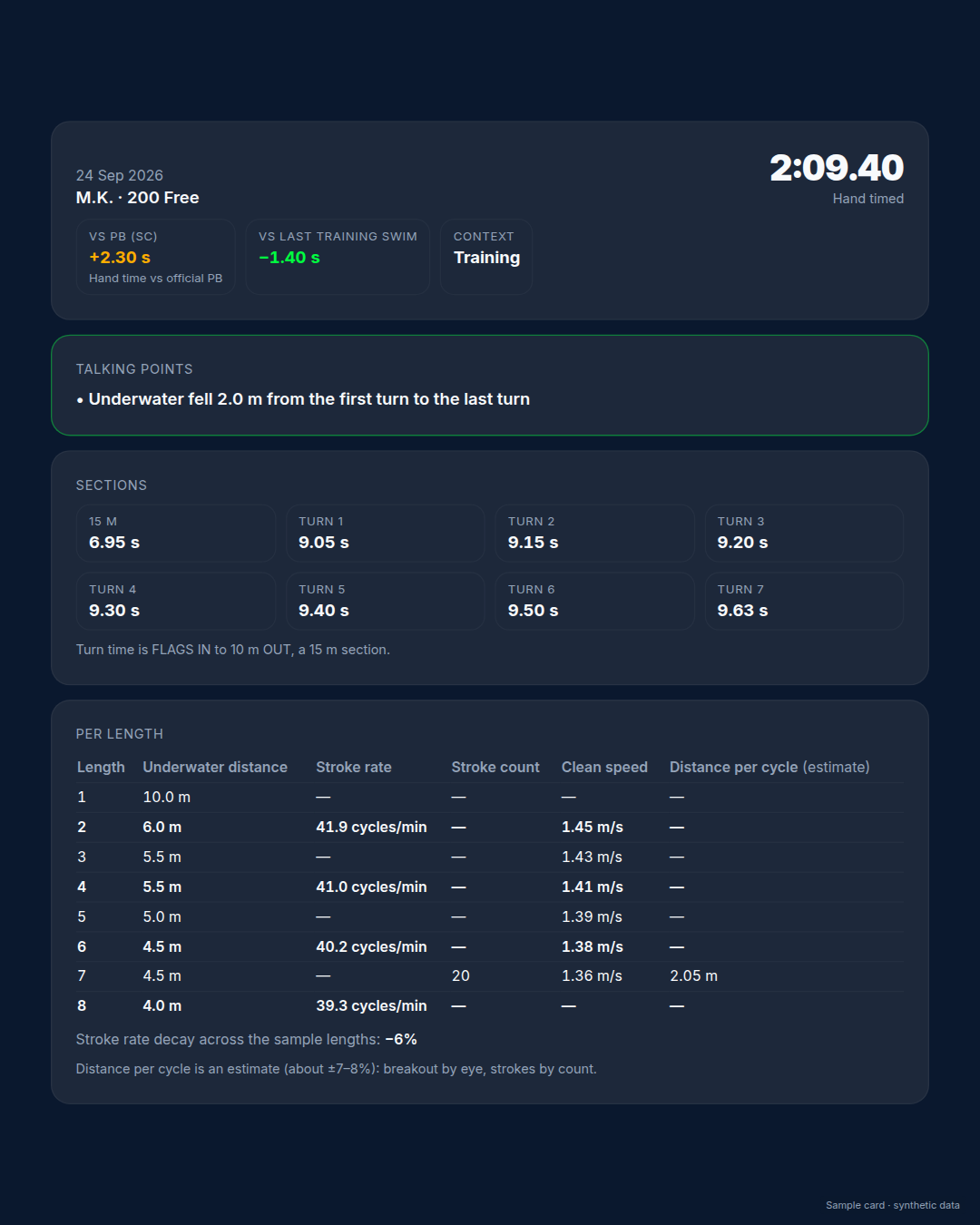
You tap as the swimmer passes 15 m, 10 m out and the flags, then the touch. Tap through three stroke cycles and you have a stroke rate for that length. After each wall you mark where they broke out on a strip of lane rope on the screen. The card then works out what you'd want to know anyway: how long the turns took from flags in to 10 m out, how fast they were actually swimming once the wall stopped helping, and how far each stroke carried them.
Most of that is arithmetic. What took longest was deciding what the card should say about it.
We got that badly wrong first time. The early version compared every turn with the dive, so on the test cards almost everyone had a note telling them their turns were weaker than their start. Well, yes. Nobody carries as far off a push as off a block. A coach would read that once, roll their eyes and never look at the talking points again. Fair enough, too.
That's the real risk with anything that tells a coach what to look at. Give them two obvious points and they won't read the third, and the third might have been the useful one.
So it says much less now. It flags underwaters that fade by a metre and a half or more between the first turn and the last, and it flags a race where the turns are coming up a metre shorter, on average, than the last time that swimmer swam the event. The 1.5 isn't arbitrary. You're judging a breakout by eye from the side of the pool, and to the nearest half metre is about as good as that gets, so a fade of a metre could be you as easily as the swimmer. Averaging over every turn in the race takes some of that error out, which is why the second rule can sit lower.
Hand times worry us more than anything else on the card. Thumbs are late on the start, so hand times tend to read quick, and a flattering time on a card a 14-year-old might see does real harm. If a hand time comes in more than 3% under the swimmer's official PB, the card won't treat it as one. The PB tile goes amber and says Check. On a two-minute 200 that's over three and a half seconds, and nobody's thumb is that slow. It's usually a missed length or the wrong lane.
Stroke rates that look implausible get the same treatment. Anything under 20 or over 70 cycles a minute is kept, marked, and left out of the talking points.
It works in training too, on a race-pace set or a time trial. Those swims are only ever compared with other training swims, they're labelled as hand timed, and they never touch a PB. We didn't want a good Thursday morning turning up on someone's best times.
The practical side took longer than the maths. Some pools have barely any signal at the balcony end, and tablets like to dim themselves halfway through a 200. Every tap saves on the device before it tries to sync, and the screen is kept awake. Swimmers show as initials only, since whatever is on that tablet is in full view of the parents' gallery.
There's no camera in it, and no AI. People have asked about video. We'd rather not hold footage of other people's children, and a coach watching the race and tapping at the right moment is still the best sensor on poolside.
What we don't know yet is whether it survives a real session. A 50 free might be too quick to tap through cleanly. The bigger question is whether one coach can capture while another runs the team, because if that doesn't work, none of the rest matters much. We'll write the 10th up properly afterwards, including whatever breaks.